


 瑞薩RZ/G2L微處理器Linux內(nèi)核中熱管理框架介紹

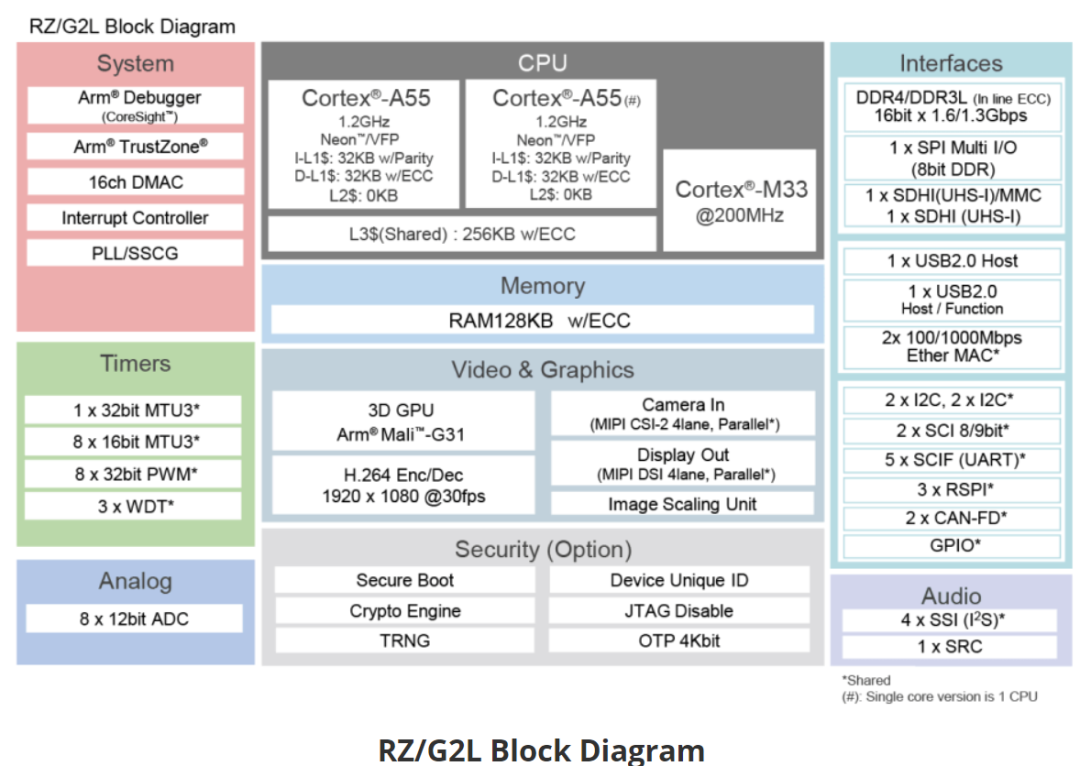
RZ/G2L微處理器配備Cortex-A55(1.2 GHz)CPU、16位DDR3L/DDR4接口、帶Arm Mali-G31的3D圖形加速引擎以及視頻編解碼器(H.264)。此外,這款微處理器還配備有大量接口,如攝像頭輸入、顯示輸出、USB2.0和千兆以太網(wǎng),因此特別適用于入門級(jí)工業(yè)人機(jī)界面(HMI)和具有視頻功能的嵌入式設(shè)備等應(yīng)用,具備較好的能耗比。
隨著計(jì)算設(shè)備性能的不斷提升,處理器、GPU、NPU的功耗和發(fā)熱量顯著增加,如何有效管理系統(tǒng)溫度成為計(jì)算機(jī)系統(tǒng)設(shè)計(jì)中的重要課題。
如果沒有適當(dāng)?shù)臒峁芾恚^高的溫度會(huì)對(duì)系統(tǒng)穩(wěn)定性、性能和壽命造成嚴(yán)重影響。如高溫會(huì)導(dǎo)致電子元件的物理特性發(fā)生變化,例如電阻增大、信號(hào)延遲增加,甚至可能引發(fā)數(shù)據(jù)傳輸錯(cuò)誤。當(dāng)溫度超過芯片的安全閾值時(shí),可能會(huì)出現(xiàn)系統(tǒng)崩潰(crash)、死機(jī)(hang)、自動(dòng)關(guān)機(jī)(shutdown)等問題。
為了避免過熱,現(xiàn)代CPU和GPU內(nèi)部通常會(huì)集成動(dòng)態(tài)溫度調(diào)節(jié)機(jī)制(Thermal Throttling),當(dāng)溫度接近上限時(shí),系統(tǒng)會(huì)主動(dòng)降低頻率(降頻)或減少運(yùn)行核心數(shù),以減少功耗和發(fā)熱量。
在Linux內(nèi)核中,Thermal Framework(熱管理框架)提供了一套完整的溫度管理機(jī)制,允許操作系統(tǒng)監(jiān)測(cè)溫度變化,并在必要時(shí)采取相應(yīng)的散熱措施。該框架主要通過CPU內(nèi)置的溫度傳感器模塊監(jiān)控設(shè)備溫度,并結(jié)合散熱設(shè)備(如風(fēng)扇、散熱膜、導(dǎo)熱膠等)和溫控策略(如動(dòng)態(tài)電壓調(diào)節(jié)、核心關(guān)閉、降頻或負(fù)載均衡)來優(yōu)化系統(tǒng)散熱。
RZ/G2L工作溫度

本篇概要介紹下瑞薩RZ/G2L thermal軟件策略。
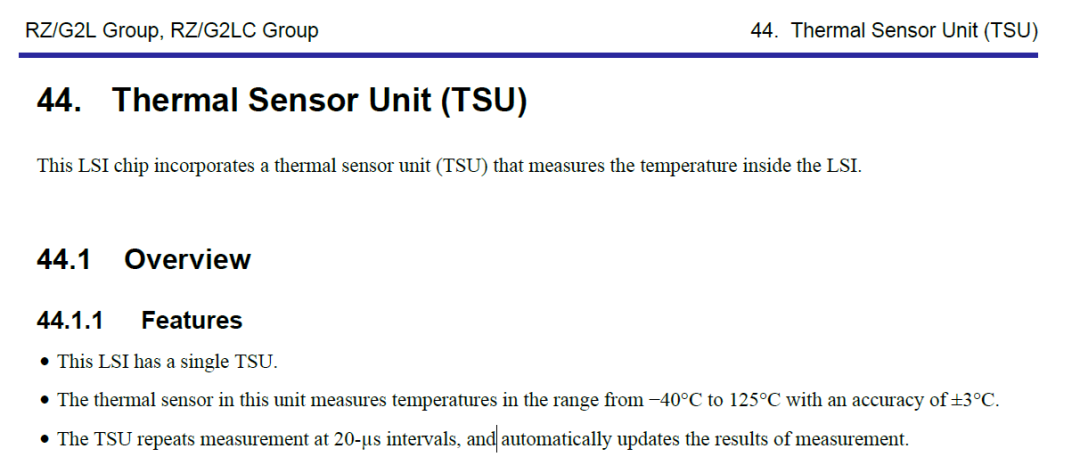
硬件上依賴芯片內(nèi)部的TSU(熱傳感器單元)。
規(guī)格如下
軟件框架如下
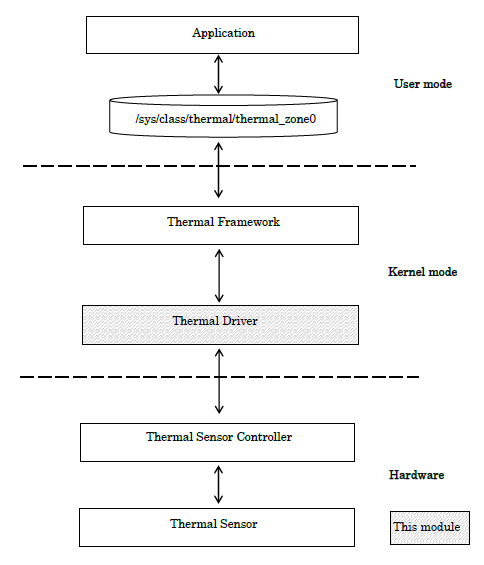
一般產(chǎn)品開發(fā)者只需要配置對(duì)應(yīng)策略的參數(shù)即可,如內(nèi)核設(shè)備樹,具體驅(qū)動(dòng)原廠已經(jīng)適配。
如下詳細(xì)介紹設(shè)備樹參數(shù)
左右滑動(dòng)查看完整內(nèi)容
tsu: thermal@10059400{
compatible ="renesas,r9a07g044-tsu",
  "renesas,rzg2l-tsu";
reg = <00x1005940000x400>;
clocks = <&cpg CPG_MOD R9A07G044_TSU_PCLK>;
resets = <&cpg R9A07G044_TSU_PRESETN>;
power-domains = <&cpg>;
#thermal-sensor-cells =<1>;
};


thermal-zones {
emergency {
polling-delay = <1000>;      /* 每隔1000ms獲取一次溫度 */
on-temperature = <110000>; /* 超過110度,關(guān)閉 cpu1 */
off-temperature = <95000>;  /* 低于95度,恢復(fù) cpu1 */
target_cpus =  <&cpu1>;    /* 是否關(guān)閉 cpu1 */
status ="disabled";
};


cpu-thermal {
polling-delay-passive = <250>; /* 溫度高于trip-point-0指定的值,每隔250ms獲取一次溫度 */
polling-delay = <1000>;   /* 溫度低于trip-point-0指定的值,每隔1000ms獲取一次溫度 */
thermal-sensors = <&tsu?0>;  /* 通過tsu 通道0獲取溫度 */
sustainable-power = <717>; /* 溫度等于trip-point-1指定的值時(shí),系統(tǒng)分配給cooling device的能量 */


cooling-maps {
map0 {
trip = <&target>;    /* 表示在target trip下,該cooling device才起作用 */
cooling-device = <&cpu0?02>;  /* cpufreq 的頻點(diǎn)從最高到最小頻點(diǎn)排序,從0開始標(biāo)注,0對(duì)應(yīng)最高頻率*/
contribution = <1024>;   /* 1024 整數(shù)倍,用于調(diào)整降頻順序和尺度 */
};
};


trips {
sensor_crit: sensor-crit {
temperature = <125000>; // 默認(rèn)關(guān)機(jī)溫度,具體動(dòng)作由thermal_core.c 函數(shù) handle_critical_trips決定。
hysteresis = <1000>;
type ="critical";
};


target: trip-point {
temperature = <100000>;  /* 100 度發(fā)生溫控,對(duì)應(yīng) trip_point_1_temp 文件 */hysteresis = <1000>;      /* 滯后溫度,當(dāng)下降到(100 – 5000/1000) = 95 度時(shí)解除溫控,對(duì)應(yīng) trip_point_1_hyst 文件 */type ="passive";         /* ”passive”,表示當(dāng)溫控發(fā)生后由governor控制policy */};};};}; cpus {#address-cells =<1>;#size-cells =<0>; cpu-map {cluster0 {core0 {cpu =<&cpu0>;};core1 {cpu =<&cpu1>;};};}; cpu0: cpu@0 {compatible ="arm,cortex-a55";reg =<0>;device_type ="cpu";#cooling-cells =<2>;next-level-cache =<&L3_CA55>;enable-method ="psci";clocks =<&cpg CPG_CORE R9A07G044_CLK_I>;operating-points-v2 =<&cluster0_opp>;}; cpu1: cpu@100 {compatible ="arm,cortex-a55";reg =<0x100>;device_type ="cpu";next-level-cache =<&L3_CA55>;enable-method ="psci";clocks =<&cpg CPG_CORE R9A07G044_CLK_I>;operating-points-v2 =<&cluster0_opp>;}; L3_CA55: cache-controller-0 {compatible ="cache";cache-unified;
cache-size = <0x40000>;
};
};


cpu 頻率
cluster0_opp: opp-table-0{
compatible ="operating-points-v2";
opp-shared;


opp-150000000{
opp-hz = /bits/64<150000000>;
opp-microvolt = <1100000>;
clock-latency-ns = <300000>;
};
opp-300000000{
opp-hz = /bits/64<300000000>;
opp-microvolt = <1100000>;
clock-latency-ns = <300000>;
};
opp-600000000{
opp-hz = /bits/64<600000000>;
opp-microvolt = <1100000>;
clock-latency-ns = <300000>;
};
opp-1200000000{
opp-hz = /bits/64<1200000000>;
opp-microvolt = <1100000>;
clock-latency-ns = <300000>;
opp-suspend;
};
};
左右滑動(dòng)查看完整內(nèi)容
測(cè)試信息節(jié)點(diǎn):
當(dāng)前溫度:cat/sys/class/thermal/thermal_zone0/temp
工作頻率:cat/sys/devices/system/cpu/cpu0/cpufreq/cpuinfo_cur_freq
          cat/sys/devices/system/cpu/cpu1/cpufreq/cpuinfo_cur_freq
cpu是否在線:cat/sys/devices/system/cpu/cpu*/online
可以通過熱風(fēng)槍或溫箱設(shè)備模擬環(huán)境加熱,如上配置參數(shù)的控制過程。
總結(jié)如下
左右滑動(dòng)查看完整內(nèi)容
cpu溫度
超過100度,啟動(dòng)降頻 1.2G ->0.6G -> 0.3G
超過110度,關(guān)閉cpu1,并降頻至 0.15G
超過125度,關(guān)機(jī);
Linux Thermal框架的核心價(jià)值在于平衡性能與溫度,通過智能熱管理提升系統(tǒng)穩(wěn)定性、延長(zhǎng)硬件壽命、優(yōu)化功耗,并提供靈活的適配性,使其成為計(jì)算設(shè)備熱管理的關(guān)鍵組件。
產(chǎn)品設(shè)計(jì)參考
rzg2l-thermal-management-guideline
https://www.renesas.cn/zh/document/apn/rzg2l-thermal-management-guideline?r=1467981
rzg2l-power-consumption-measurement
https://www.renesas.cn/zh/document/apn/power-consumption-measurement?r=1467981
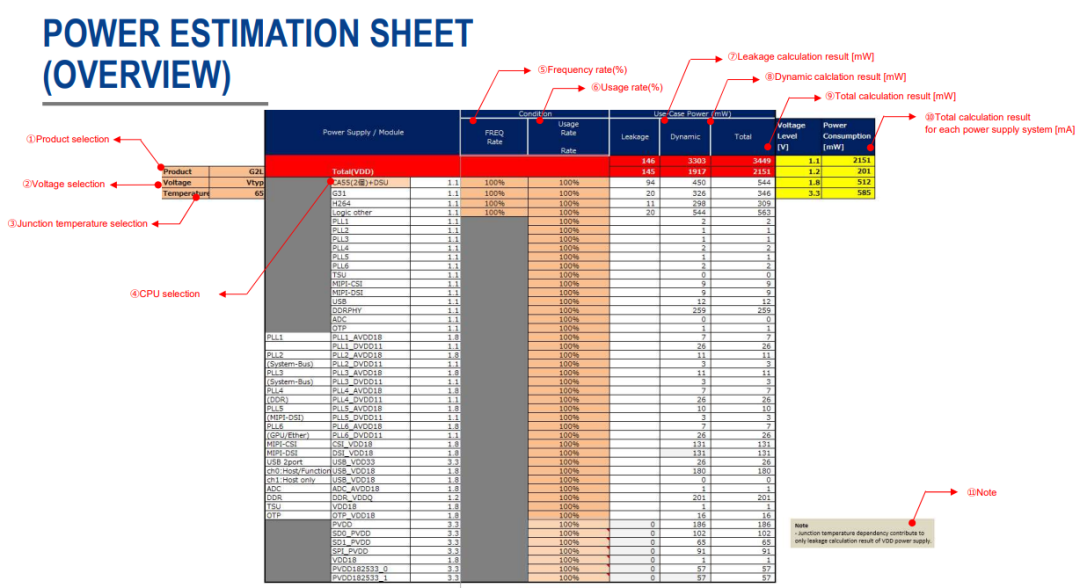
如果需要如下詳細(xì)功率計(jì)算表,請(qǐng)聯(lián)系銷售或于本公眾號(hào)后臺(tái)菜單欄點(diǎn)擊“樣片申請(qǐng)”聯(lián)系相應(yīng)合作商獲取。
-
Linux
+關(guān)注
關(guān)注
88文章
11785瀏覽量
219307 -
瑞薩
+關(guān)注
關(guān)注
37文章
22500瀏覽量
91001 -
微處理器
+關(guān)注
關(guān)注
11文章
2434瀏覽量
86030 -
熱管理
+關(guān)注
關(guān)注
11文章
542瀏覽量
23017
原文標(biāo)題:瑞薩RZ/G2L Linux Thermal Framework軟件熱管理介紹
文章出處:【微信號(hào):瑞薩嵌入式小百科,微信公眾號(hào):瑞薩嵌入式小百科】歡迎添加關(guān)注!文章轉(zhuǎn)載請(qǐng)注明出處。
發(fā)布評(píng)論請(qǐng)先 登錄
瑞薩MCU方案:瑞薩RZ/G2L Bootloader單獨(dú)編譯方法詳解
基于瑞薩電子RZ/G2L的FET-G2LD-C核心板和OK-G2LD-C開發(fā)板評(píng)測(cè)
RZ/G2L Linux系統(tǒng)如何添加新的內(nèi)核模塊
瑞薩RZ/G2L串口SCI的使用(上)
瑞薩RZ/G2L微處理器的SD卡GPIO控制功能介紹
G2L系列 核心板 -RZ/G2L 處理器簡(jiǎn)介|框架圖|功耗|原理圖及硬件設(shè)計(jì)指南
【米爾瑞薩RZ/G2L開發(fā)板-試用體驗(yàn)】開箱
【米爾瑞薩RZ/G2L開發(fā)板-試用體驗(yàn)】米爾瑞薩RZ/G2L開發(fā)板開箱視頻
【米爾瑞薩RZ/G2L開發(fā)板-試用體驗(yàn)】米爾瑞薩RZ/G2L開發(fā)板使用SSH登錄
【米爾瑞薩RZ/G2L開發(fā)板-試用體驗(yàn)】認(rèn)識(shí)一下米爾瑞薩RZ/G2L開發(fā)板的核心板
瑞薩電子推全新RZ/G2L MPU,可實(shí)現(xiàn)降低整體系統(tǒng)成本
瑞薩RZ/G2L處理器詳細(xì)測(cè)評(píng)

瑞薩RZ/G2L Linux Thermal Framework軟件熱管理介紹



 工商網(wǎng)監(jiān)
評(píng)論