


 使用AsyncInferQueue進一步提升AI推理程序的吞吐量

本文將介紹基于OpenVINO的異步推理隊列類 AyncInferQueue,啟動多個(>2)推理請求(infer request),幫助讀者在硬件投入不變的情況下,進一步提升 AI 推理程序的吞吐量(Throughput)。
在閱讀本文前,請讀者先了解使用 start_async() 和 wait() 方法實現(xiàn)基于2個推理請求的異步推理實現(xiàn)方式。該異步推理實現(xiàn)方式相對于同步推理方式,極大提升了 AI 推理程序的吞吐量,但從任務(wù)管理器中可以看到,AI 推理硬件的利用率還有很大的提升空間。
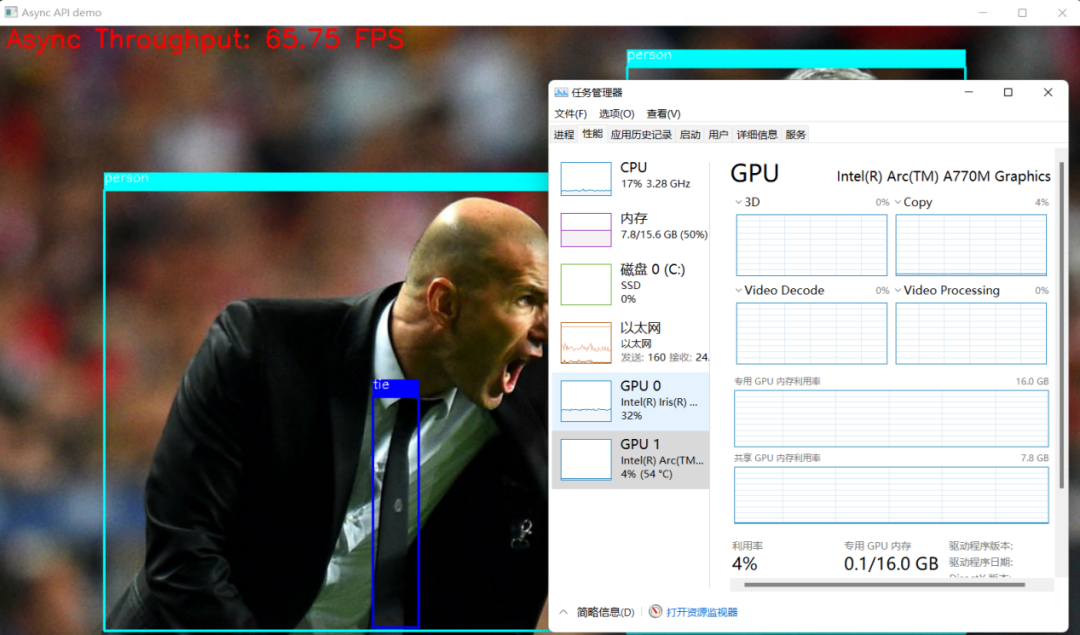
這意味著,AI 推理硬件還有潛力可挖,可以通過進一步提高推理請求個數(shù)來提升 AI 推理硬件的利用率,從而提高 AI 推理程序的吞吐量。
1.1
推理請求(InferRequest)和流(stream)
OpenVINO 運行時(Runtime)用推理請求(infer request)來抽象在指定計算設(shè)備上運行已編譯模型(Compiled_Model)。從編寫程序的角度看,推理請求是一個類,封裝了支持推理請求以同步或異步方式運行的屬性和方法。
推理請求(InferRequest)類的詳細定義參考:
https://github.com/openvinotoolkit/openvino/blob/master/src/inference/include/openvino/runtime/infer_request.hpp#L34
推理請求的個數(shù),由開發(fā)者定義;但計算設(shè)備能并行處理的推理請求個數(shù),由硬件本身的處理單元(Processing Unit)決定。超過計算硬件并行處理數(shù)量的推理請求,會被計算硬件用隊列儲存起來,當計算硬件空閑后,隊列中的推理請求將被依次取出并執(zhí)行。
OpenVINO用流(stream)來抽象計算設(shè)備能并行處理推理請求的能力,通過屬性:“NUM_STREAMS”,可以獲取延遲優(yōu)先或吞吐量優(yōu)先模式下的計算硬件支持的最優(yōu)streams數(shù)量,如下表所示。

:上述數(shù)據(jù)在蝰蛇峽谷上測得,CPU=i7-12700H, 集成顯卡=Iris Xe, 獨立顯卡=A770m
: GPU設(shè)備沒有INFERENCE_NUM_THREADS屬性
上述數(shù)據(jù)測試的源代碼如下,歡迎各位讀者在自己的硬件平臺上測試:
from openvino.runtime import Core, get_version
core = Core()
print(get_version())
print(core.available_devices)
device = device = ['GPU.0', 'GPU.1', 'CPU', 'AUTO', 'AUTO:GPU,-CPU'][0]
cfgs = {}
cfgs['PERFORMANCE_HINT'] = ['THROUGHPUT', 'LATENCY', 'CUMULATIVE_THROUGHPUT'][0]
net = core.compile_model("model.onnx",device,cfgs)
# Get Supported properties
supported_properties = net.get_property('SUPPORTED_PROPERTIES')
print(f'Support properties for {device}:', supported_properties)
opt_nireq = net.get_property('OPTIMAL_NUMBER_OF_INFER_REQUESTS')
print(f'OPTIMAL_NUMBER_OF_INFER_REQUESTS for {device}:', opt_nireq)
nstreams = net.get_property('NUM_STREAMS')
print(f'nstreams for {device}:', nstreams)
performance_hint_num_requests = net.get_property('PERFORMANCE_HINT_NUM_REQUESTS')
print(f'performance_hint_num_requests for {device}:', performance_hint_num_requests)
if device == "CPU":
  # INFERENCE_NUM_THREADS
  inference_num_threads = net.get_property('INFERENCE_NUM_THREADS')
  print(f'inference_num_threads for {device}:', inference_num_threads)
else:
  gpu_queue_priority = net.get_property('GPU_QUEUE_PRIORITY')
print(f'GPU queue priority for {device}:', gpu_queue_priority)
向右滑動查看完整代碼
1.1.1
CPU 的流與推理請求
對于 CPU 來說,一個流(stream)只能服務(wù)一個推理請求。通過屬性ov::range_for_streams,可以查到 CPU 支持的流數(shù)量的范圍;流的數(shù)量無需開發(fā)者使用代碼顯示設(shè)置,OpenVINO 運行時會根據(jù)延遲優(yōu)先或吞吐量優(yōu)先來自動設(shè)置。

1.1.2
GPU 的流與推理請求
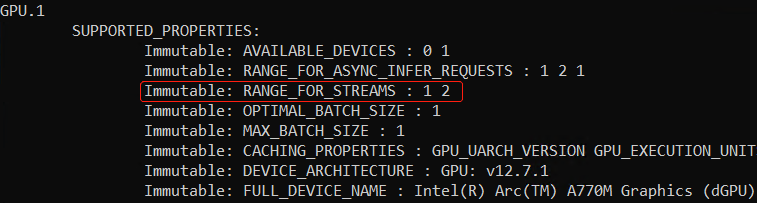
對于 GPU 來說,一個流(stream)可以同時服務(wù)兩個推理請求。通過屬性 ov::range_for_streams,可以查到 GPU 支持的流數(shù)量的范圍:[1, 2];流的數(shù)量無需開發(fā)者使用代碼顯示設(shè)置,OpenVINO 運行時會根據(jù)延遲優(yōu)先或吞吐量優(yōu)先來自動設(shè)置。
參考代碼:
https://www.jianshu.com/p/1748444e6a50
1.2
AsyncInferQueue類
OpenVINO運行時(Runtime)提供 AsyncInferQueue 類來抽象并管理異步推理請求池,其常用方法和屬性有:
__init__(self, compiled_model, jobs = 0):創(chuàng)建AsyncInferQueue對象
set_callback(func_name):為推理請求池中所有的推理請求設(shè)置統(tǒng)一的回調(diào)函數(shù)
start_async(inputs, userdata = None):異步啟動推理請求
wait_all():等待所有的推理請求執(zhí)行完畢
1.2.1
基于AsyncInferQueue類的
異步推理范例程序
基于 AsyncInferQueue 類 YOLOv5 模型的異步推理范例程序的核心代碼部分如下所示:
完整范例代碼請下載:yolov5_async_infer_queue.py
https://gitee.com/ppov-nuc/yolov5_infer/blob/main/yolov5_async_infer_queue.py
運行代碼前,請參考運行環(huán)境搭建流程。
...
def preprocess(frame):
  # Preprocess the frame
  letterbox_im, _, _= letterbox(frame, auto=False) # preprocess frame by letterbox
  im = letterbox_im.transpose((2, 0, 1))[::-1] # HWC to CHW, BGR to RGB
  im = np.float32(im) / 255.0  # 0 - 255 to 0.0 - 1.0
  blob = im[None] # expand for batch dim
  return blob, letterbox_im.shape[:-1], frame.shape[:-1]
def postprocess(ireq: InferRequest, user_data: tuple):
  result = ireq.results[ireq.model_outputs[0]]
  dets = non_max_suppression(torch.tensor(result))[0].numpy()
  bboxes, scores, class_ids= dets[:,:4], dets[:,4], dets[:,5]
  # rescale the coordinates
  bboxes = scale_coords(user_data[1], bboxes, user_data[2]).astype(int)
  print(user_data[0],"	"+f"{ireq.latency:.3f}"+"	", class_ids)
  return
# Step1:Initialize OpenVINO Runtime Core
core = Core()
# Step2: Build compiled model
device = device = ['GPU.0', 'GPU.1', 'CPU', 'AUTO', 'AUTO:GPU,-CPU'][0]
cfgs = {}
cfgs['PERFORMANCE_HINT'] = ['THROUGHPUT', 'LATENCY', 'CUMULATIVE_THROUGHPUT'][0]
net = core.compile_model("yolov5s.xml",device,cfgs)
output_node = net.outputs[0]
b,n,input_h,input_w = net.inputs[0].shape
# Step3: Initialize InferQueue
ireqs = AsyncInferQueue(net)
print('Number of infer requests in InferQueue:', len(ireqs))
# Step3.1: Set unified callback on all InferRequests from queue's pool
ireqs.set_callback(postprocess)
# Step4: Read the images
image_folder = "./data/images/"
image_files= os.listdir(image_folder)
print(image_files)
frames = []
for image_file in image_files:
  frame = cv2.imread(os.path.join(image_folder, image_file))
  frames.append(frame)
# 4.1 Warm up
for id, _ in enumerate(ireqs):
  # Preprocess the frame
  start = perf_counter()
  blob, letterbox_shape, frame_shape = preprocess(frames[id % 4])
  end = perf_counter()
  print(f"Preprocess {id}: {(end-start):.4f}.")
  # Run asynchronous inference using the next available InferRequest from the pool
  ireqs.start_async({0:blob},(id, letterbox_shape, frame_shape))
ireqs.wait_all()
# Step5: Benchmark the Async Infer
start = perf_counter()
in_fly = set()
latencies = []
niter = 16
for i in range(niter):
  # Preprocess the frame
  blob, letterbox_shape, frame_shape = preprocess(frames[i % 4])
  idle_id = ireqs.get_idle_request_id()
  if idle_id in in_fly:
    latencies.append(ireqs[idle_id].latency)
  else:
    in_fly.add(idle_id)
  # Run asynchronous inference using the next available InferRequest from the pool
  ireqs.start_async({0:blob},(i, letterbox_shape, frame_shape) )
ireqs.wait_all()
向右滑動查看完整代碼
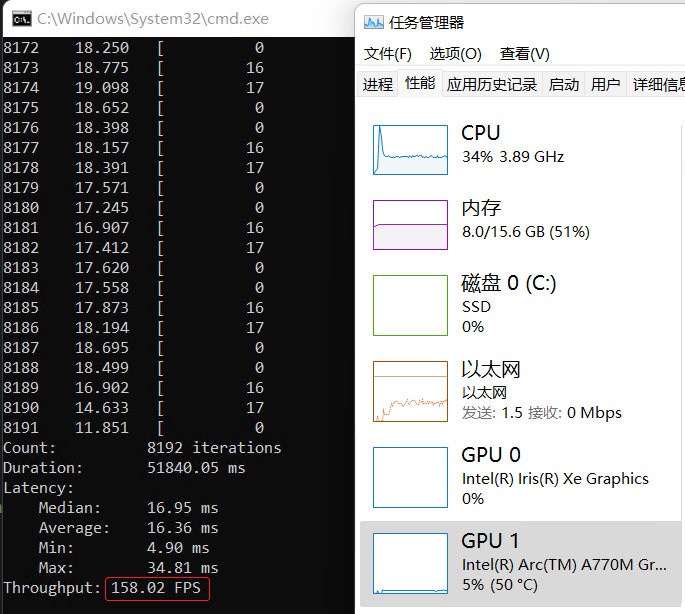
運行結(jié)果如下所示,與基于單個推理請求的start_async()+wait()實現(xiàn)方式相比,基于 AsyncInferQueue 類的 YOLOv5 模型的異步推理程序的吞吐量明顯得到提升。
1.3
結(jié)論
使用 OpenVINO Runtime 的 AsyncInferQueue 類,可以極大提升 AI 推理程序的吞出量。
審核編輯 :李倩
-
AI
+關(guān)注
關(guān)注
91文章
39793瀏覽量
301443 -
程序
+關(guān)注
關(guān)注
117文章
3846瀏覽量
85246 -
任務(wù)管理器
+關(guān)注
關(guān)注
0文章
15瀏覽量
7942
原文標題:使用AsyncInferQueue進一步提升AI推理程序的吞吐量 | 開發(fā)者實戰(zhàn)
文章出處:【微信號:英特爾物聯(lián)網(wǎng),微信公眾號:英特爾物聯(lián)網(wǎng)】歡迎添加關(guān)注!文章轉(zhuǎn)載請注明出處。
發(fā)布評論請先 登錄
百度蘿卜快跑與Uber進一步深化戰(zhàn)略合作
DeepX OCR:以 DeepX NPU 加速 PaddleOCR 推理,在 ARM 與 x86 平臺交付可規(guī)模化的高性能 OCR 能力

用“分區(qū)”來面對超大數(shù)據(jù)集和超大吞吐量
天合儲能與Lightshift Energy進一步擴大戰(zhàn)略合作
BlackBerry QNX與芯馳科技進一步深化戰(zhàn)略合作
BlackBerry QNX與眾森軟件進一步深化戰(zhàn)略合作
上汽奧迪與創(chuàng)維汽車智能合作進一步深化升級
使用羅德與施瓦茨CMX500的吞吐量應(yīng)用層測試方案



 工商網(wǎng)監(jiān)
評論