


 STM32驅動MAX30102心率血氧傳感器(OLED顯示)

簡介
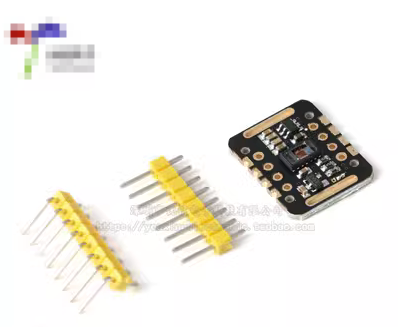
MAX30102是一個集成的脈搏血氧儀和心率監測儀模塊。它包括內部led,光電探測器,光學元件,和低噪聲電子與環境光排斥。MAX30102提供了一個完整的系統解決方案,以簡化移動和可穿戴設備的設計過程。MAX30102運行在一個1.8V電源和一個單獨的3.3V電源上。通信是通過一個標準的i2c兼容的接口。該模塊可以通過零備用電流的軟件關閉,允許電源軌道始終保持供電。
電氣參數
| 工作電壓 | 1.8-5V |
|---|---|
| 工作電流 | 1.5mA |
| 心率精確度 | +/-5bpm(靜態),+/-10bpm(動態) |
| 信號接口 | IIC |
| 分辨率 | 1bpm |
系統框圖
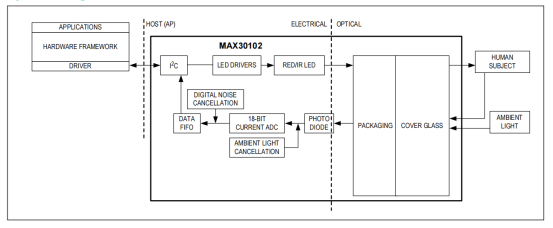
MAX30102是一個完整的脈搏血氧儀和心率傳感器系統解決方案模塊,為可穿戴設備的苛刻要求而設計。該設備保持了一個非常小的解決方案尺寸,而不犧牲光學或電氣性能。集成到可穿戴系統中需要最小的外部硬件組件。MAX30102可以通過軟件寄存器進行完全可調,并且數字輸出數據可以存儲在IC內的一個32深的FIFO中。FIFO允許MAX30102連接到共享總線上的微控制器或處理器,在其中,數據不會從MAX30102的寄存器中連續讀取。MAX30102有一個片上的溫度傳感器,用于校準SpO2子系統的溫度依賴性。該溫度傳感器的固有分辨率0.0625°C。器件輸出數據對紅外LED的波長相對不敏感,其中紅色LED的波長對正確解釋數據至關重要。與MAX30102輸出信號一起使用的SpO2算法可以補償環境溫度變化時的相關SpO2誤差。
接線
| STM 32 | MAX30102 | OLED | USB -TTL |
|---|---|---|---|
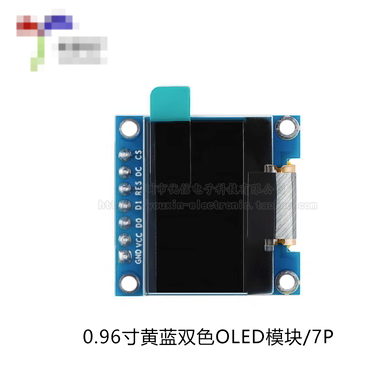
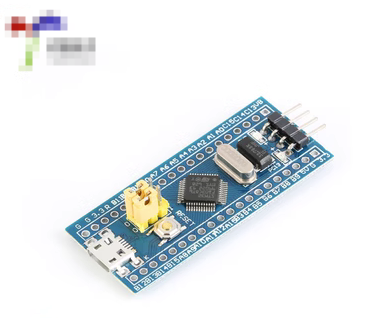
| 3.3V | VCC | VCC | 3.3V |
| GND | GND | GND | GND |
| PB7 | SCL | - | - |
| PB8 | SDA | - | - |
| PB9 | IM | - | - |
| PA5 | - | SCL | - |
| PA6 | - | SDA | - |
| PA3 | - | RST | - |
| PA4 | - | DC | - |
| PA2 | - | CS | - |
| PA9 | - | - | RXD |
| PA10 | - | - | TXD |
代碼
#include "led.h"
#include "delay.h"
#include "sys.h"
#include "usart.h"
#include "max30102.h"
#include "myiic.h"
#include "algorithm.h"
#include "oled.h"

uint32_t aun_ir_buffer[500]; //IR LED sensor data
int32_t n_ir_buffer_length;    //data length
uint32_t aun_red_buffer[500];    //Red LED sensor data
int32_t n_sp02; //SPO2 value
int8_t ch_spo2_valid;   //indicator to show if the SP02 calculation is valid
int32_t n_heart_rate;   //heart rate value
int8_t  ch_hr_valid;    //indicator to show if the heart rate calculation is valid
uint8_t uch_dummy;

#define MAX_BRIGHTNESS 255

void dis_DrawCurve(u32* data,u8 x);

int main(void)
{
	//variables to calculate the on-board LED brightness that reflects the heartbeats
	uint32_t un_min, un_max, un_prev_data;
	int i;
	int32_t n_brightness;
	float f_temp;
	u8 temp_num=0;
	u8 temp[6];
	u8 str[100];
	u8 dis_hr=0,dis_spo2=0;

	NVIC_Configuration();
	delay_init();	    	 //延時函數初始化
	uart_init(115200);	 	//串口初始化為115200
	LED_Init();

	//OLED
	OLED_Init();
	OLED_ShowString(0,0,"  initializing  ",16);
	OLED_Refresh_Gram();//更新顯示到OLED

	max30102_init();

	printf("rn MAX30102  init  rn");

	un_min=0x3FFFF;
	un_max=0;

	n_ir_buffer_length=500; //buffer length of 100 stores 5 seconds of samples running at 100sps
	//read the first 500 samples, and determine the signal range
    for(i=0;i< n_ir_buffer_length;i++)
    {
        while(MAX30102_INT==1);   //wait until the interrupt pin asserts

		max30102_FIFO_ReadBytes(REG_FIFO_DATA,temp);
		aun_red_buffer[i] =  (long)((long)((long)temp[0]&0x03)< < 16) | (long)temp[1]< < 8 | (long)temp[2];    // Combine values to get the actual number
		aun_ir_buffer[i] = (long)((long)((long)temp[3] & 0x03)< < 16) |(long)temp[4]< < 8 | (long)temp[5];   // Combine values to get the actual number

        if(un_min >aun_red_buffer[i])
            un_min=aun_red_buffer[i];    //update signal min
        if(un_max< aun_red_buffer[i])
            un_max=aun_red_buffer[i];    //update signal max
    }
	un_prev_data=aun_red_buffer[i];
	//calculate heart rate and SpO2 after first 500 samples (first 5 seconds of samples)
    maxim_heart_rate_and_oxygen_saturation(aun_ir_buffer, n_ir_buffer_length, aun_red_buffer, &n_sp02, &ch_spo2_valid, &n_heart_rate, &ch_hr_valid);

	while(1)
	{
		i=0;
        un_min=0x3FFFF;
        un_max=0;

		//dumping the first 100 sets of samples in the memory and shift the last 400 sets of samples to the top
        for(i=100;i< 500;i++)
        {
            aun_red_buffer[i-100]=aun_red_buffer[i];
            aun_ir_buffer[i-100]=aun_ir_buffer[i];

            //update the signal min and max
            if(un_min >aun_red_buffer[i])
            un_min=aun_red_buffer[i];
            if(un_max< aun_red_buffer[i])
            un_max=aun_red_buffer[i];
        }
		//take 100 sets of samples before calculating the heart rate.
        for(i=400;i< 500;i++)
        {
            un_prev_data=aun_red_buffer[i-1];
            while(MAX30102_INT==1);
            max30102_FIFO_ReadBytes(REG_FIFO_DATA,temp);
			aun_red_buffer[i] =  (long)((long)((long)temp[0]&0x03)< < 16) | (long)temp[1]< < 8 | (long)temp[2];    // Combine values to get the actual number
			aun_ir_buffer[i] = (long)((long)((long)temp[3] & 0x03)< < 16) |(long)temp[4]< < 8 | (long)temp[5];   // Combine values to get the actual number

            if(aun_red_buffer[i] >un_prev_data)
            {
                f_temp=aun_red_buffer[i]-un_prev_data;
                f_temp/=(un_max-un_min);
                f_temp*=MAX_BRIGHTNESS;
                n_brightness-=(int)f_temp;
                if(n_brightness< 0)
                    n_brightness=0;
            }
            else
            {
                f_temp=un_prev_data-aun_red_buffer[i];
                f_temp/=(un_max-un_min);
                f_temp*=MAX_BRIGHTNESS;
                n_brightness+=(int)f_temp;
                if(n_brightness >MAX_BRIGHTNESS)
                    n_brightness=MAX_BRIGHTNESS;
            }
			//send samples and calculation result to terminal program through UART
			if(ch_hr_valid == 1 && n_heart_rate< 120)//**/ ch_hr_valid == 1 && ch_spo2_valid ==1 && n_heart_rate< 120 && n_sp02< 101
			{
				dis_hr = n_heart_rate;
				dis_spo2 = n_sp02;
			}
			else
			{
				dis_hr = 0;
				dis_spo2 = 0;
			}
				printf("HR=%i, ", n_heart_rate);
				printf("HRvalid=%i, ", ch_hr_valid);
				printf("SpO2=%i, ", n_sp02);
				printf("SPO2Valid=%irn", ch_spo2_valid);
		}
        maxim_heart_rate_and_oxygen_saturation(aun_ir_buffer, n_ir_buffer_length, aun_red_buffer, &n_sp02, &ch_spo2_valid, &n_heart_rate, &ch_hr_valid);

		//顯示刷新
		LED0=0;
		if(dis_hr == 0 && dis_spo2 == 0)  //**dis_hr == 0 && dis_spo2 == 0
		{
			sprintf((char *)str,"HR:--- SpO2:--- ");//**HR:--- SpO2:---
		}
		else{
			sprintf((char *)str,"HR:%3d SpO2:%3d ",dis_hr,dis_spo2);//**HR:%3d SpO2:%3d
		}
		OLED_ShowString(0,0,str,16);
		OLED_Fill(0,23,127,63,0);
		//紅光在上,紅外在下
		dis_DrawCurve(aun_red_buffer,20);
		dis_DrawCurve(aun_ir_buffer,0);
		OLED_Refresh_Gram();//更新顯示到OLED
	}
}

void dis_DrawCurve(u32* data,u8 x)
{
	u16 i;
	u32 max=0,min=262144;
	u32 temp;
	u32 compress;

	for(i=0;i< 128*2;i++)
	{
		if(data[i] >max)
		{
			max = data[i];
		}
		if(data[i]< min)
		{
			min = data[i];
		}
	}

	compress = (max-min)/20;

	for(i=0;i< 128;i++)
	{
		temp = data[i*2] + data[i*2+1];
		temp/=2;
		temp -= min;
		temp/=compress;
		if(temp >20)temp=20;
		OLED_DrawPoint(i,63-x-temp,1);
	}
}
結果
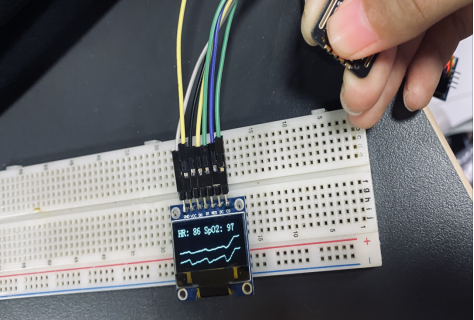
總結
手指放置紅色LED上,OLED上會顯示心率、血氧值,并且還有波形顯示,剛開始數值和波形會有些波動,靜置幾秒后,數值和波形方可穩定。
聲明:本文內容及配圖由入駐作者撰寫或者入駐合作網站授權轉載。文章觀點僅代表作者本人,不代表電子發燒友網立場。文章及其配圖僅供工程師學習之用,如有內容侵權或者其他違規問題,請聯系本站處理。
舉報投訴
-
OLED
+關注
關注
121文章
6357瀏覽量
233619 -
STM32
+關注
關注
2309文章
11162瀏覽量
373399 -
心率監測儀
+關注
關注
0文章
5瀏覽量
7637 -
血氧傳感器
+關注
關注
1文章
13瀏覽量
4575
發布評論請先 登錄
相關推薦
熱點推薦
基于STM32物聯網開發板(7)--心率血氧采集MAX30102
MAX30102是一種集成的脈搏血氧計心率監測模塊。它包括內部LED,光電探測器、光學元件和低噪聲電子器件具有環境光抑制。
MAX30102血氧模塊的原理及編程 精選資料分享
一.簡介MAX30102是一個集成的脈搏血氧儀和心率監測儀生物傳感器的模塊(芯片)。它集成了一個660nm紅光LED、880nm紅外光LED
發表于 07-19 09:15
max30102心率血氧傳感器
這個傳感器讓我了解了很多,以前使用的單片機,基本沒有遇見過堆棧溢出的問題,這個傳感器讓我遇到了,在此記錄調試心得。首先把所有驅動文件都貼出來了心率血
發表于 08-20 07:52
DFRobot心率血氧傳感器有哪些,心率血氧傳感器的原理
DFRobot Gravity: MAX30102 心率血氧傳感器模塊搭載了美信(maxim)的MAX3




 工商網監
工商網監
評論