


 德克薩斯大學(xué):研究石墨烯電子紋身電生理傳感,用于潛水員安全檢測

危險且缺乏保護的水下作業(yè)是潛水員死亡的主要原因;生物傳感器可提供早期預(yù)警和部分保護,從而在一定程度上減輕這一風(fēng)險。然而,當(dāng)前生物傳感器的復(fù)雜性和高成本限制了其廣泛應(yīng)用,凸顯了對有效、成本效益高且多功能生理監(jiān)測解決方案的迫切需求。本文,德克薩斯大學(xué)Deji Akinwande、馬薩諸塞大學(xué)Dmitry Kireev等在《ACS Applied Electronic Materials》期刊發(fā)表名為“Electrophysiological Sensing with Graphene Electronic Tattoos for Saline and Underwater Environments”的論文,研究開發(fā)了一種非侵入式防水石墨烯電生理傳感器,可在鹽水環(huán)境中檢測多種生理信號,從而克服現(xiàn)有水下監(jiān)測技術(shù)的局限性。通過采用原子級薄的石墨烯界面和簡單的防水涂層方法,我們實現(xiàn)了在皮膚表面采集心電圖(ECG)、肌電圖(EMG)和皮膚電活動(EDA)信號。
此外,我們通過EDA信號準(zhǔn)確評估了驚嚇事件,這對于評估潛水員壓力和預(yù)防事故至關(guān)重要。該防水石墨烯生物傳感器展現(xiàn)出卓越的電學(xué)性能,包括在10 kHz頻率下阻抗低至約2.4 kΩ·cm2、EMG信號信噪比超過21 dB,以及EDA信號響應(yīng)速度高達(dá)0.125 μS/(s·cm2),所有測試均在鹽水條件下進行。本研究為防水石墨烯電生理傳感器在鹽水環(huán)境中的巨大潛力提供了有力證據(jù),為提升潛水員安全性和降低事故風(fēng)險提供了解決方案。
2圖文導(dǎo)讀
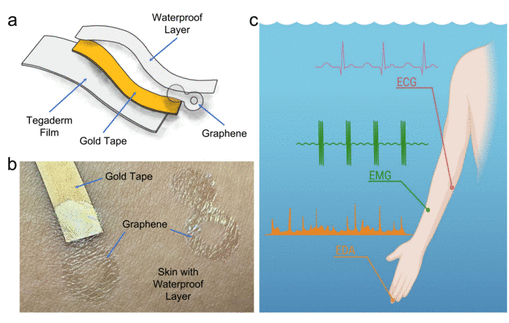
圖1. Water-resistant GET (Graphene Electronic Tattoo) structure and functional diagram. (a) Schematic representation of the integrated structure of SCC-GET. (b) Close-up optical photograph of a single GET, and a GET connected to gold tape adhered to the forearm. The skin surface has been treated with a waterproof coating. (c) Schematic representation of a SCC-GET sensor, which is capable of detecting electrocardiogram (ECG), electromyogram (EMG), and electrodermal activity (EDA) signals in saline environments.
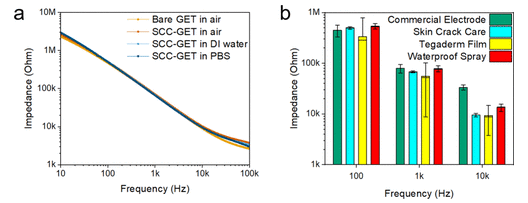
圖2. Comparative impedance spectra of GET under diverse coating conditions for water resistance performance. (a) Skin crack care (SCC) coated GET full spectrum impedance sweep for all test conditions. (b) The mean impedance of GET using different waterproofing methods (Tegaderm film-coated commercial electrodes, Tegaderm film-coated GET, Skin Crack Care (SCC) coated GET, and Waterproof spray-coated GET), under different test conditions (bare in air, coated in air, coated in DI water, and coated in PBS solution), measured at different frequencies (100 Hz, 1 kHz, and 10 kHz). The area of the commercial electrodes was normalized to match the surface area of the GET for comparative analysis.
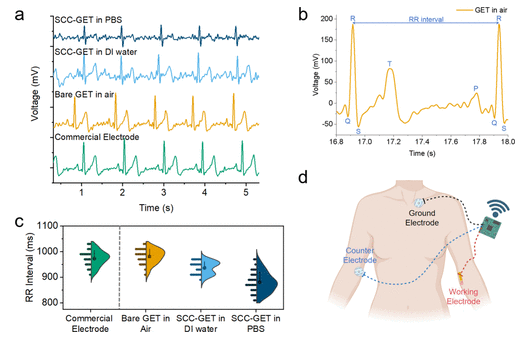
圖3. ECG signal recorded from SCC coated GET. (a) ECG signals measured in air from GET (light orange), under 30 cm of deionized (DI) water (light blue), under 30 cm of PBS solution (dark blue), and Ag/AgCl commercial electrodes (green) in air. (b) ECG signal measured by GET in air, capturing a complete cardiac cycle and marking the different phases within the cycle. (c) Violin plot of sinus rhythm R–R intervals (heart rate) calculated from ECG signals under different conditions. The width of the violin represents the data density, the center bar shows the interquartile range, and the dot within the bar marks the median. (d) Diagram of three-lead ECG signal measurement.
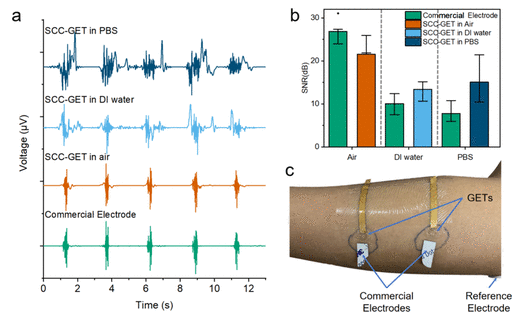
圖4. EMG signal recorded from SCC coated GET. (a) EMG signals measured simultaneously in air from SCC-GET (dark orange) and Ag/AgCl commercial electrodes (green). EMG signals from SCC-GET measured under 30 cm of deionized (DI) water (light blue) and under 30 cm of PBS solution (dark blue). (b) Signal-to-noise ratio for different measurement conditions (n= 12, 10 grabs, and 2 holds). The bars represent the mean values, with error bars indicating the standard deviation (mean ± SD). (c) Optical photograph of simultaneous EMG signal measurements using graphene electrodes and commercial electrodes (cut into 0.25 cm2), located on the subject’s forearm.
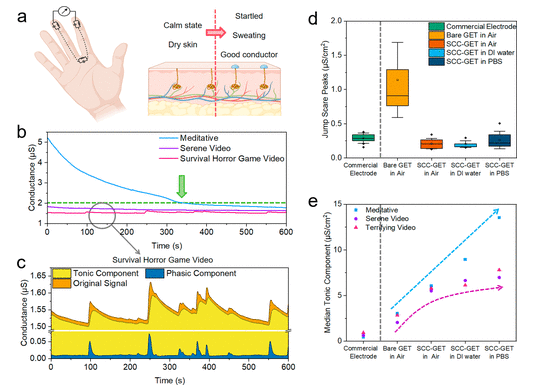
圖5. EDA signal recorded from SCC coated GET. (a) Schematic diagram of the working principle for EDA signal measurement. (b) EDA signals measured with SCC-GET in DI water, recorded while subjects watched three types of videos: meditative, serene, and terrifying. The green dashed line indicates where subjects stabilized their emotional fluctuations, while the green arrow highlights the specific moment. (c) EDA signals measured with SCC-GET in DI water, recorded while subjects watched a 10 min terrifying video. (d) Comparison of EDA signal peaks (using area-normalized conductance) while watching terrifying videos measured with SCC-GET under different conditions (DI water, PBS, air) and commercial electrodes (air only). Normalized by area (n= 9 for commercial metal button electrodes in air,n= 9 for bare GET in air,n= 7 for SCC-GET in air,n= 6 for SCC-GET in DI,n= 8 for SCC-GET in PBS). The box represents 25% and 75% with a mean; outliers are ±SD. (e) Comparison of EDA signals baselines (median of tonic component), using area-normalized conductance, measured with GET under different conditions and commercial electrodes in air.
3小結(jié)
研究推出了一種新型皮膚裂紋護理增強型防水石墨烯電子紋身(SCC-GET),展示了其在鹽水環(huán)境中各種生物電子應(yīng)用中的有效性。通過將原子級薄的石墨烯與柔性、透明且防水的層相結(jié)合,SCC-GET實現(xiàn)了亞微米級厚度,并能與人體皮膚無縫貼合,不受運動影響,使其成為迄今為止在鹽水條件下報道的最薄的電生理傳感器。SCC-GET的便捷組裝特性使其可同時放置于多個身體部位以同步檢測生命體征信號。總體而言,本研究證實了SCC-GET在多種生物電子應(yīng)用中的優(yōu)異性能與可靠性,為先進生理監(jiān)測系統(tǒng)的發(fā)展奠定了基礎(chǔ),尤其在海洋等極端環(huán)境中具有廣闊應(yīng)用前景。
審核編輯 黃宇
-
石墨烯
+關(guān)注
關(guān)注
54文章
1615瀏覽量
85305 -
安全檢測
+關(guān)注
關(guān)注
0文章
28瀏覽量
6994
發(fā)布評論請先 登錄
一文讀懂石墨檢測:為何它是石墨產(chǎn)業(yè)的“質(zhì)量守門人”?

鎖相放大器在觀察石墨烯自發(fā)對稱性破缺的量子輸運測量的應(yīng)用
高壓功率放大器在三維石墨烯應(yīng)變傳感網(wǎng)絡(luò)研究中的應(yīng)用
用于氧化石墨烯的多模態(tài)表征與激光還原圖案化的共聚焦顯微技術(shù)

香港理工大學(xué)、南方科技大學(xué):新型壓阻式石墨烯/CNC聲學(xué)傳感器,用于語音識別
深圳大學(xué):研發(fā)新型傳感器,實現(xiàn)阿摩爾級生物分子精準(zhǔn)檢測
深圳技術(shù)大學(xué):超薄石墨烯應(yīng)變傳感器陣列,用于毫米級分辨率的高靈敏度多功能傳感
高精度TLM測量技術(shù):在金屬-石墨烯接觸電阻表征中的應(yīng)用研究

東華大學(xué):研究基于石墨烯纖維的高性能壓力傳感器,具有雙邊致密結(jié)構(gòu),用于人體運動監(jiān)測
安徽大學(xué):基于聚乙烯醇/絲素蛋白/石墨烯水凝膠的柔性傳感器,用于先進的可穿戴電子產(chǎn)品等
中科院寧波材料所:雙結(jié)構(gòu)石墨烯/PDMS復(fù)合傳感器,用于可穿戴設(shè)備應(yīng)用
EastWave應(yīng)用:光場與石墨烯和特異介質(zhì)相互作用的研究
浙江大學(xué):研究石墨烯基嗅覺傳感陣列實現(xiàn)細(xì)菌和病毒性呼吸道感染的快速區(qū)分
人工合成石墨片與天然石墨片的差別
石墨烯增強生物基凝膠導(dǎo)熱和導(dǎo)電性能研究



 工商網(wǎng)監(jiān)
評論